Saturday, December 1, 2012

Beginning work to complete branch line

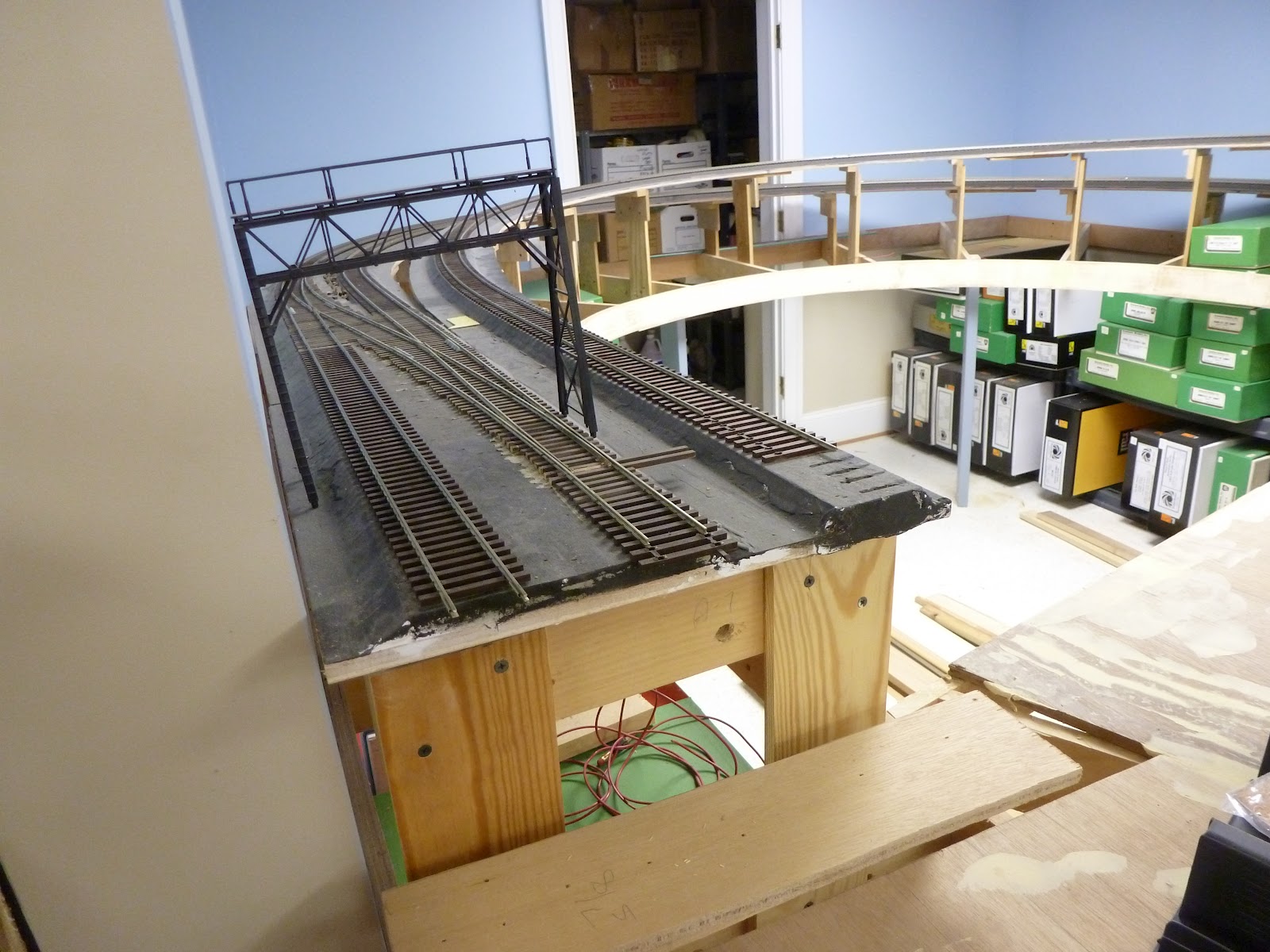
Looking westward
We are now beginning to plan how the branch line will rise from Weigh Scales and reach the holding tracks that have been hanging from the ceiling for the past two years. You can see the red wire hanging down from the entrance to the six track loop. We have to rise about 15 inches, cross the aisle here on a Through Truss bridge of 40 inches in length, while maintaining about a 30 inch aisle. The bench work will be about shoulder height to make the actual walk way wider. Those grey brackets on the wall will hold the bench work. The cross member will be attached to the top of the bracket and then we will have a knee brace.
 I am standing where a representation of Shamokin will be on the wall to my right at about my head height. The Glen Bourne colliery will be above that cardboard (gathered for scenery forms) leaning against the wall.


Continuing to the west towards Weigh Scales
 Walking down to the corner, we come the the curve leading to Weigh Scales which is our gathering yard. We have the river on the outboard side, PA Highway 61 is to the right of the track and high on the hill is an S Scale track to represent the Reading line through the Narrows.
The Narrows with the Reading high above
 This is a more complete view of the Narrows. Weigh Scales is just around to the left where my electrical supplies sit. The track is rising on a 3% grade to make the climb to get the bridge over the aisle to about a 72 inch clearance from the floor.
Looking at the Narrows but back eastward
Looking back eastward to where we started
These last two views are looking back at where we have come from. A good view of the Narrows with Shamokin Creek in the foreground in the first shot. The second shot gives you a view back to where the bridge will be. The line will then curve around to the right over the existing main and continue to rise about another 8 inches to meet the holding tracks over my right shoulder. We are having active discussions about how to scenic this whole thing but more on that later.

Saturday, November 10, 2012

After a Long Absence


Well, it has been a while since a post. This is due to a long trip on the West Coast, a case of pneumonia that I never expected - what a long recuperation - and getting ready for a visit by 23 railroaders from as far away as Charleston, SC; Gettysburg, PA,; Baltimore and Finksburg, MD and Indianapolis, IN. Those, plus my old group up in the DC area. So, I have been under and over the layout, doing some basic wiring so that we now have both main lines operating, plus the branch all the way into the yard. I will show you the wiring in another post. This one is just an illustration of the guys having a good time. They visited another layout in the area, Ed Rappe's, and then came to my house. We had a 3 unit set of Baldwin Sharks pulling a 45 car train, an M1b (4-8-2) pulling a 35 car train and double headed I1's (2-10-0) pulling a 35 car hopper train up and down the branch.
 The guys who follow the blog said that they did not appreciate how big the yard was until they saw it in person. I am going to try another approach and post again in the near future to help solve that problem. 
 Meanwhile, the layout ran well and the guys liked it very much. On their previous visit, they did not understand my description of what we were going to do but they now have a full picture of the track plan. As you can tell by the pictures, we had a lot of conversation so everyone had a good time.

Our goals for the new year will include completion of the branch line, wiring and panel installation ( I will stay with DC for now) and fascia panels. Scenery will be the goal for 2014.


Friday, September 28, 2012

Bridging the Susquehanna

 Well, it is time to complete the lines over the river that were a main feature of the Northern Central as it left Northumberland eastbound, going into Sunbury. I cannot duplicate the length of the bridges but we can almost match the appearance at the end of the yard where the station was. This is going to be be a long post as there are so many steps. First I took two Atlas thru trusses - a single for the branch and a double for the main - and modified them to make them look better - not truly Proto 48 but layout grade.
 I added guard rails between the tracks using Code 100 steel rail that I had. I spiked them down after drilling holes for the spikes - every seventh tie. I extended them about 10 scale feet past each end of the bridge.
 I added some extra spikes at the end for strength.

The next really big deficiency of the bridge is the lack of gussets on the outside of the trusses.

As can be seen here, they have gussets on the inside of the trusses but these gussets do not go up over the girders which would be wrong as the gusset should tie everything together. 

 The lower gusset is correct in that it covers the whole joint. That big hole is for the  male piece on th e bridge deck to go into. A key tip - file those male pieces as they do not fit easily. If you file it, they go right in and make your life a whole lot easier.
 The below is the appearance of an outer girder junction with out a gusset. Pretty poor!
 So, I made cardboard masters by copying the overall dimensions of the inner gussets to that they would match when looked at from the side. You can see my note that I needed 8 of this one as it is for the upper corner at each end of 2 bridges. The lines gave me a guide for rivets to tie the girders in.
This is the completed .020 styrene gusset with the rivets embossed. 

The double track bridge is now complete with gussets installed, bridge painted, deck weathered and bridge footings placed. I used some old Auel bridge footings that I had bought years ago. 

Now you can see the single track bridge is done also.The piers are from Scenic Express. I cut two in pieces and meshed the stone work together. I colored the stone based on some pictures a friend of mine took in Pennsylvania last year.  

You can see the cut line in the back of the pier. The bridges look nice - with the new gussets and guard rails.


Some more views

Okay, now we have the opening. The is the yard side of the river. Track is loose, awaiting the bridges.

The east side is mostly laid. I did have to move the branch line slightly to the right as the footings separated the bridges more than I had initially figured.

You can see that I had a pretty good match on the double track bridge. I had only to move the track slightly and the back track had enough flex.

The yard side is now in

Here it is from the yard perspective. The main looks nice going onto the bridge. Now for the branch line.

Both bridges set side by side

Branch line track approaching. This is a temporary track as I will have to lay a wye here to give better access to the turntable to eastbound engines. More on that later.

Hammer at the ready for fine adjustments!

Track is down and we have the first crossing by a branch line train after 4 years of construction

Looks good!

This is especially good as we did have a wreck here last year when a train drifted down the branch unattended and dumped a caboose and 4 hoppers onto the floor through the open gap.

Over view of train heading up the branch.


Wednesday, July 18, 2012

Working on the roster

 Well, as I mentioned in the previous post, I decided to take a break from the layout to work on some I1's that will be used on the branch line. I have 7 of the Sunset I1's and 2 USH models. Here are 6 of the 7 Sunset's. The one on the far left has been completely redone by Frank Miller for me. I am going to use it as a guide as I redo the other 5. The seventh one is an Altoona version that is in the paint shop right now. I have just finished building 5 front assemblies and pilots for the models using Grabowski tanks and chin platforms. It took a special jig that was made by an old friend, Ray Jury, who is no longer with us, coupled with a MAPP torch to get them to heat high enough to solder together. It is the most distinctive thing on the I1's. They were called Hippo's because of those paired tanks. They look a whole lot better now.
 As you look at the engine on this end you can see it has a lot more detail on it. My plan is to go at this in assemblies and my next task is to replace the main rods with Grabowski castings. To do this, I have to set up my mill to be able to drill the rods and then mill off the rears where they attach to the crosshead and piston.
 Another rather quick change are the smoke stacks and sand domes by Bill Brisko. You can see how much larger they are than the original parts by Sunset. The first model has them and all the others do not. These are going to be layout models., not contest models so I am trying to get them to look good but not perfect.
Here is a left side view of a completed engine and a factory model. I have to change the feedwater heater to a later version, add a bunch of better castings, edge the running boards, and add an ash hopper and details. I think each engine will take about a week of solid work. Those pilot assemblies took me about 2 solid weeks.

Wednesday, July 4, 2012

Starting the Engine Terminal

 Sad to say, I have run out of turnout parts from Trackside so am waiting on an order to get back to building turnouts. These are the turnouts into the diesel(foreground) and steam areas. I need to build the steam area first as I have to climb over the benchwork where the diesels will go.
While not really prototypical, I am planning on using an Ogle coaling tower for the terminal area. It is about the best detailed coaling tower out there so I decided to use it. I have drawn the location of the round house, which will be facing us, and the coaling tower will be on the left side of it.  I need to lay three tracks here, inbound, outbound and coal delivery. The inbound track will have a pit and it will be managed by a Burro crane with a hopper. That track will be switched using the turntable. All turnouts will be number 7's so we have no engine troubles. 

This is an overview of the East end ladder. The caboose track will be coming up on the left side of the HD 40 can. That is going to take some cutting as the running track is a quarter higher in elevation than the yard. I am taking a break while waiting on the turnout parts and replacing all the tanks on five Sunset I1 front ends with Grabowski parts. These engines will power the branch line trains.

Adding the Thoroughfare Track

 The next step, which has taken a while, is to add the thoroughfare track that allows the road engines to escape back to the engine facility. I used Old Pullman track from this one as it is at the outer edge of the yard and I wanted the appearance of spikes holding the rail, not clamps as on the older Atlas tie strips that I used for the code 125 rail in the yard.  I figure that once the rail is painted and ballasted, you won't notice them but the outer track will stand out. So, here we have the track turning off the Arrival track and going down a slight slope to the level of the yard tracks.
The first turnout we come to is for the future RIP track for quick running repairs to cars that come in from the West. It will be located at the top of the photo 

We then continue on and rejoin the base of the ladder track which comes in from the left.  I used a number 7 turnout here and for the next one so that I can send my J1's through here with no worries.

The next turnout will lead tot he Ice House that was in Northumberland for servicing any through reefers. I have it facing to the West as the loaded cars would be coming from there and unloaded cars would not need much service going back. The Ice House will be generally where the white box is right now.

We continue around the outer edge of the yard and begin the swing back towards the engine service area.

This is an overview looking up the line to the turnouts that lead to the engine service area and the tracks up the other end of the ladder.

Here we are looking up the other (west) end of the ladder. We have a number 8 switch leading on the right to first a number 6 to the diesel service area, and then a number 7 to the steam service area. The white template is for a turnout for a caboose lead that bypasses the ladder and a storage area for passenger cars and a wreck train.